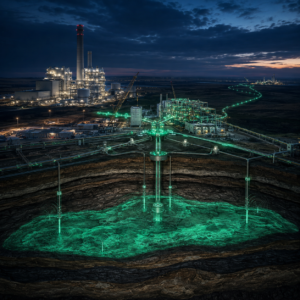

Europe has reached an important milestone in industrial carbon capture and storage (CCS), with Yara’s Sluiskil plant in the Netherlands beginning operations as the largest commercial CCS project in Europe.
Located in Sluiskil in the Zeeland province, the project is designed to capture and liquefy up to 800,000 tonnes of CO₂ per year from ammonia production. The captured CO₂ will then be transported by ship to Norway and permanently stored beneath the Norwegian North Sea through the Northern Lights storage facility.
The project demonstrates how carbon management infrastructure can connect industrial emitters across national borders with offshore geological storage.
A Cross-Border CO₂ Value Chain
Yara Sluiskil is more than a capture project. It brings together the main components of a large-scale CO₂ value chain.
CO₂ is captured at Yara’s ammonia and fertiliser facility in the Netherlands, liquefied for transportation, shipped to Norway and permanently stored beneath the North Sea.
The project is expected to store approximately 12 million tonnes of CO₂ over 15 years.
This model could become increasingly important for European industries that do not have suitable geological storage resources close to their facilities. Rather than requiring every industrial site to develop its own storage solution, shared transport and storage infrastructure can connect multiple emitters to regional storage hubs.
Public and Private Investment Come Together
The development of Yara Sluiskil also highlights the importance of coordinated public and private investment.
The CO₂ will be stored through Northern Lights, a facility supported by the European Union under the Connecting Europe Facility.
The project also reflects the cooperation established through the EU-Norway Green Alliance, signed in 2023.
Industry, governments and European institutions have therefore played complementary roles in creating the infrastructure required to move CCS from individual demonstrations toward commercial deployment.
Why Sluiskil Matters for Industrial Decarbonisation
Ammonia and fertiliser production are among the industrial processes where reducing emissions can be particularly challenging.
By targeting CO₂ generated during ammonia production, the Sluiskil project provides a pathway to reduce emissions from an existing industrial process without relying entirely on replacing the underlying production system.
The project is therefore relevant not only to the European fertiliser industry, but also to other energy-intensive sectors assessing carbon capture as part of their decarbonisation strategies.
The Next Challenge Is Scale
The start of operations is an important milestone, but Europe’s wider CCS ambitions will depend on whether projects like Sluiskil can be replicated and connected into larger networks.
That will require continued development of:
CO₂ transport infrastructure
Shared storage hubs
Cross-border regulatory frameworks
Long-term storage liability and monitoring
Predictable carbon policy and project economics
The commercial success of early projects will be particularly important in demonstrating that integrated CO₂ transport and storage networks can operate at scale.
What This Means for the European CCS Market
Yara Sluiskil represents a shift in Europe’s CCS market from project development toward operational, cross-border carbon infrastructure.
The significance of the project is not only its annual capture capacity. It is the demonstration that captured CO₂ can move through an international value chain from an industrial source in the Netherlands to permanent offshore storage in Norway.
As more European emitters consider CCS, this type of infrastructure model could provide the foundation for a broader European CO₂ network, linking industrial clusters with shared transport and geological storage capacity.
For developers, emitters and investors, the Sluiskil project offers an important commercial signal: CCS is moving from individual demonstration projects toward integrated infrastructure designed for long-term industrial decarbonisation.