Carbon capture in the US Gulf Coast just got a very large anchor customer.
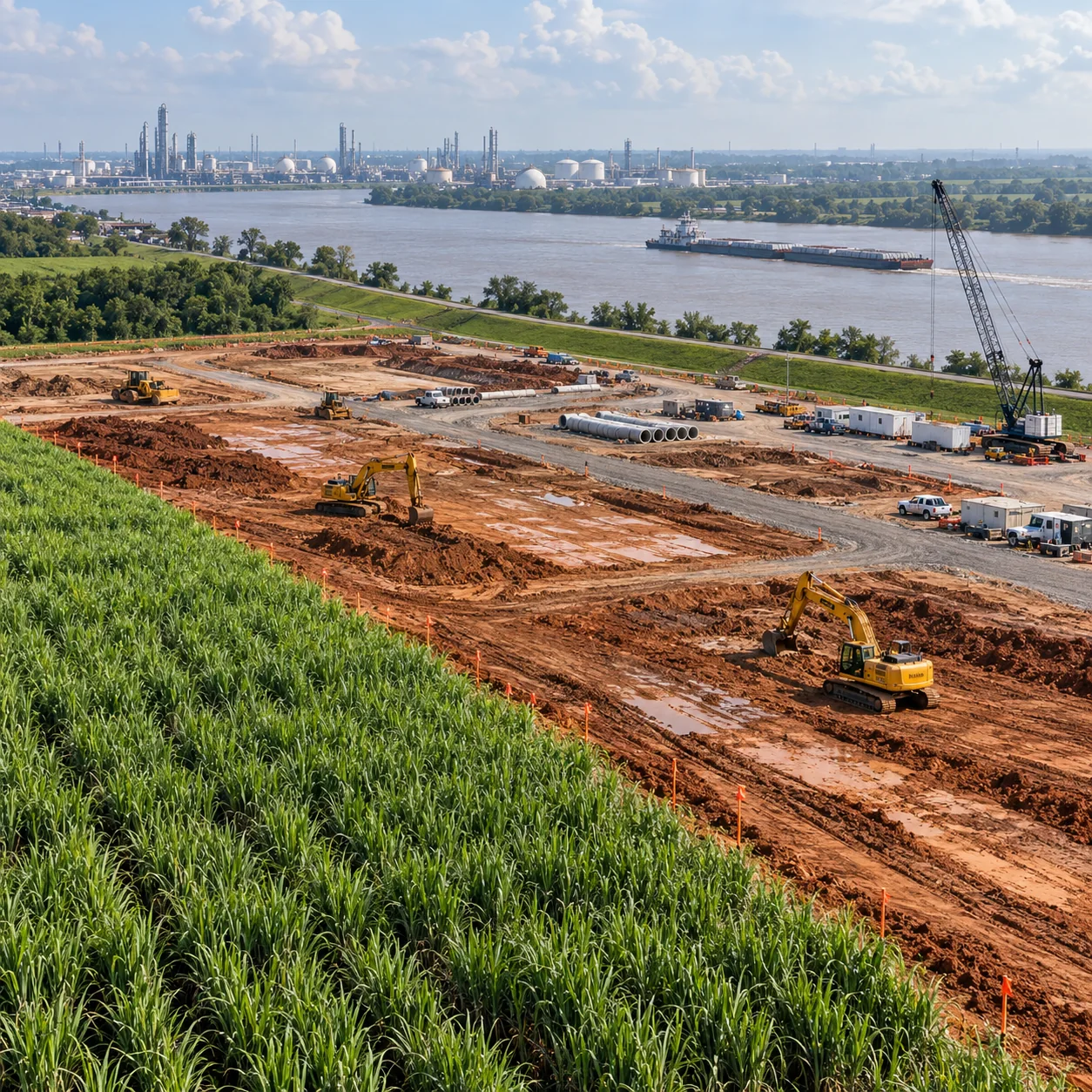
On August 26, CF Industries, JERA and Mitsui broke ground on Blue Point One, a $3.7 billion low-carbon ammonia plant in Modeste, Louisiana, which the partners describe as the world’s largest. The facility is designed to produce 1.4 million metric tons of ammonia a year and to capture and permanently sequester 98% of the CO₂ generated in production.
The project is owned 40% by CF Industries, 35% by JERA and 25% by Mitsui, and is expected to begin operating in 2029. Carbon transport and storage will be handled by a joint venture between Occidental subsidiary 1PointFive and Enbridge.
For the CCUS industry, this is the kind of project that turns storage capacity from a plan into a business.
Ammonia Is Where Capture Makes the Most Sense
Ammonia production is one of the most natural fits for carbon capture. Making hydrogen from natural gas produces a concentrated CO₂ stream, which makes capture cheaper and simpler than at a power plant or cement kiln. According to CarbonCredits.com, global ammonia production accounts for around 450 million metric tons of CO₂ a year.
Blue Point One goes further than most earlier blue ammonia projects. It will use autothermal reforming (ATR) for hydrogen production, making it one of the first industrial-scale facilities to deploy the technology ahead of ammonia synthesis, according to CF Industries. ATR concentrates more of a plant’s emissions into a single capturable stream, which is what makes a 98% capture target credible.
That design choice matters.
Older steam methane reformers leave a share of their emissions in dilute flue gas, which is costly to capture. Building ATR into the plant from the start means the carbon management plan is part of the process design, not an addition bolted on later.
Storage Partners Are Now Part of the Deal Structure
The most telling detail for CCUS developers is who handles the CO₂. Rather than build its own storage, the joint venture has contracted transport and sequestration to the 1PointFive and Enbridge partnership.
This mirrors how the Gulf Coast market is maturing. Emitters focus on what they do well, in this case making ammonia, while specialist midstream and storage operators take the CO₂ from the plant fence. It is the same model that has made pipelines and gas processing a services business for decades.
For storage developers, a single plant of this size is a long-term volume commitment that supports pipeline and well investment. For other emitters in the region, it shows that third-party storage is becoming something that can be contracted and financed.
A Supply Chain Is Forming Around the Site
Blue Point One is not a single investment. It is drawing other capital to the site.
Linde is investing more than $400 million in an on-site air separation unit to supply the plant, according to CF Industries. CF Industries is also committing $550 million over four years to shared, scalable infrastructure at the Blue Point complex in Ascension Parish, near its existing Donaldsonville operations.
The word “scalable” is worth noticing. Shared infrastructure suggests the site has been planned with further expansion in mind. The company expects around 3,900 construction jobs over four years and more than 100 permanent manufacturing positions once the plant is running.
“This facility will serve people, growing access to the reliable, domestic nitrogen supply American farmers need to feed the world,” said Chris Bohn, CF Industries’ president and CEO.
Japanese Capital Signals Where Demand Is Heading
JERA’s 35% stake is a strong signal. As one of Japan’s largest power generators, JERA brings a demand-side view of low-carbon ammonia as an energy product, not only a fertilizer. CF Industries says the plant will serve both traditional agricultural customers and emerging energy applications.
Ammonia can be moved on existing shipping infrastructure, which makes it one of the more practical ways to export low-carbon hydrogen from the Gulf Coast to overseas buyers. Mitsui’s involvement adds trading reach and access to those markets.
The result is a project where US natural gas, US geological storage and Asian demand meet in one supply chain.
What makes this export model work?
And who else can copy it?
What Developers and Investors Should Take From It
Blue Point One offers a useful template for industrial CCUS projects at a time when capital is concentrating on the strongest projects. Its main features are:
- A high-purity CO₂ source designed for capture from the start
- Capture rates high enough to compete in low-carbon product markets
- Transport and storage contracted to specialist operators
- Ownership split between a producer, an end user and a trader
- Shared site infrastructure that can support later expansion
- Strong state and federal backing visible at groundbreaking
Political support was visible on the day. The ceremony was attended by US Secretary of Agriculture Brooke Rollins, Representative Julia Letlow and Louisiana Economic Development Secretary Susan Bourgeois, among others. That kind of backing across agriculture, energy and economic development helps protect a project through a construction period running to 2029.
The Gulf Coast Is Becoming an Industrial Carbon Corridor
Louisiana has spent several years putting the pieces of a carbon management economy in place: storage geology, pipeline developers, permitting authority and industrial demand. Blue Point One is the clearest sign yet that those pieces are coming together around real production.
The next test is execution. Construction must stay on schedule, storage must be permitted and online when the plant starts, and the 98% capture rate must hold up in operation. If it does, Blue Point One will set a standard that other ammonia, hydrogen and chemicals projects on the Gulf Coast will be measured against.
Storage capacity on its own does not build a carbon management industry.
Plants like Blue Point One, with large and steady volumes of CO₂ to store, are what make that capacity worth building.