Canada is moving another major carbon capture and storage project from development into construction, reinforcing Alberta’s position as one of the world’s most established markets for large-scale CO₂ management.
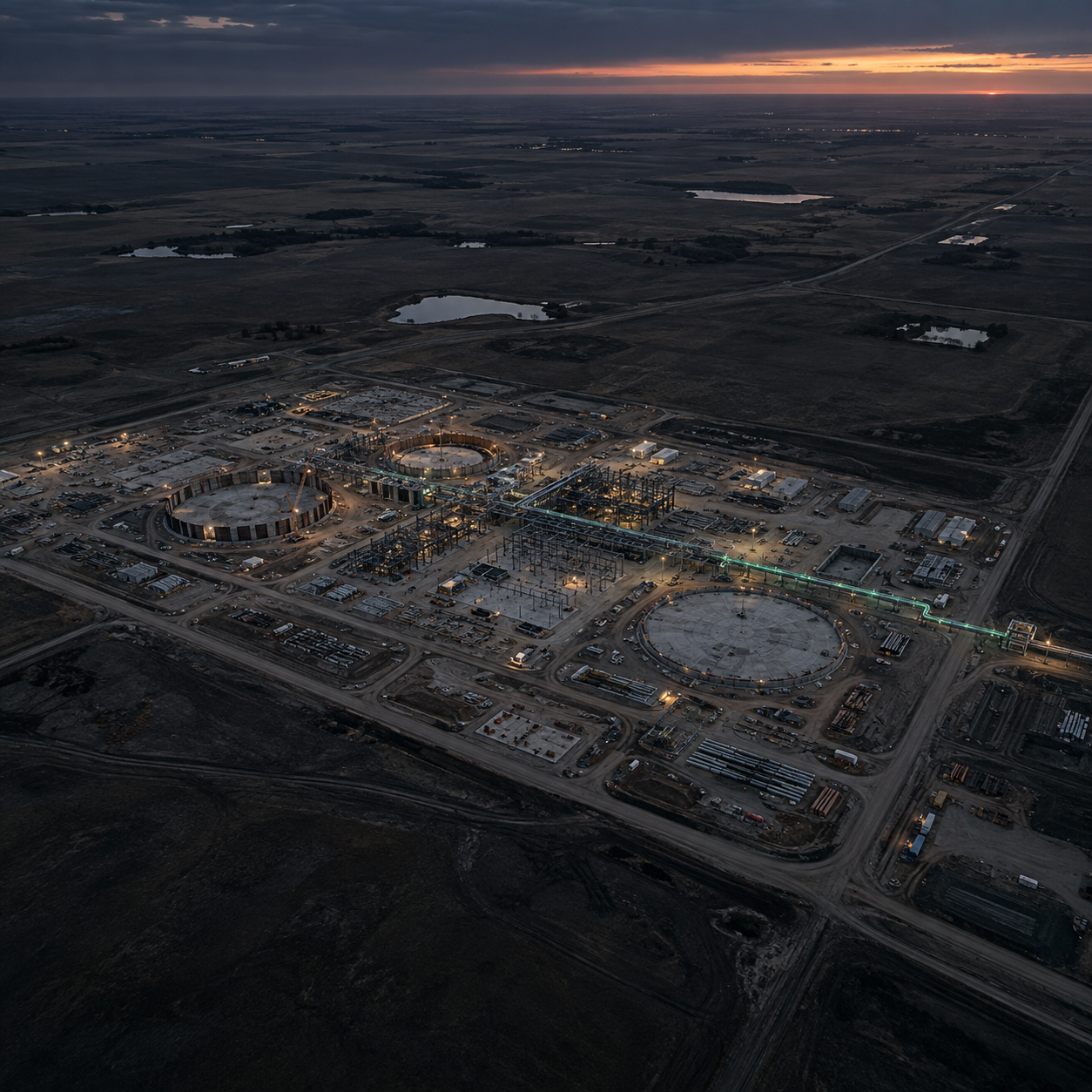
The Government of Canada, Government of Alberta and Enhance Energy have marked the start of construction of the Origins Carbon Capture Storage (CCS) Hub near Clive, Alberta.
When operations begin in January 2027, Origins is expected to become Canada’s largest CCS project, with initial capacity to permanently store up to 1.5 million tonnes of CO₂ per year.
More importantly, the project is being developed as part of an existing carbon management ecosystem.
That distinction matters.
The next stage of CCS development is increasingly about building the infrastructure that allows multiple industrial facilities to access transportation and permanent storage, rather than developing isolated capture projects one at a time.
Origins Adds Capacity to an Existing CO₂ Network
The Origins hub will connect to Alberta’s established CO₂ transportation infrastructure and initially serve industrial facilities in the province’s Industrial Heartland.
Potential customers span several emissions-intensive sectors, including oil and gas, petrochemicals, cement and power generation.
The initial 1.5-million-tonne annual storage capacity is equivalent to the emissions from more than 500,000 passenger vehicles, according to the Canadian government.
The project is also designed with expansion in mind, creating the potential for the hub to accommodate additional industrial emitters as Alberta’s carbon management network develops.
This is increasingly becoming the model for large-scale CCS.
Rather than requiring every industrial facility to develop its own transportation and storage solution, shared infrastructure can create a common pathway from multiple emissions sources to permanent geological storage.
Alberta Is Building Around Existing CCS Infrastructure
Origins is not being built in isolation.
Alberta already has significant carbon management infrastructure, including the Alberta Carbon Trunk Line (ACTL), one of the world’s largest CO₂ transportation systems.
Enhance Energy also operates the Clive CCS project, which has permanently stored more than 9 million tonnes of CO₂ since 2020.
That existing experience provides an important foundation for Origins.
The commercial challenge facing emerging CCS markets is not simply whether CO₂ can be captured or stored underground. It is whether developers can build the complete chain connecting industrial emissions to long-term storage.
That chain includes:
Capture → aggregation → transportation → injection → monitoring → permanent storage
Alberta has been developing each part of that chain for years.
Origins therefore represents an expansion of an existing ecosystem rather than a standalone experiment.
The Hub Model Could Change the Economics of Industrial CCS
One of the biggest challenges for industrial CCS is infrastructure utilization.
A capture project can require significant upfront investment before an operator has access to a reliable transportation and storage system.
A shared hub can change that equation.
Multiple emitters can potentially connect to the same transportation and storage infrastructure, spreading infrastructure costs across a larger volume of CO₂.
For industrial facilities, this can provide a clearer route to permanent storage without requiring each company to develop its own geological storage project.
For infrastructure developers, higher utilization can potentially improve the economics of pipelines and storage facilities.
That creates a network effect:
More storage capacity → more potential customers → greater infrastructure utilization → more investment → additional storage capacity.
The ability to create that cycle will be an important factor in determining which CCS markets can move from individual projects to regional carbon management systems.
CCS Is Becoming an Industrial Infrastructure Play
Origins also illustrates how the CCS conversation is changing.
Early CCS projects were often evaluated primarily on capture technology and emissions reductions.
Today’s large projects increasingly have to answer a broader set of commercial questions:
● Who will capture the CO₂?
● Who will transport it?
● Where will it be stored?
● Who owns and operates the infrastructure?
● How will storage capacity be contracted?
● How will injection and monitoring be verified?
● What incentives support the investment?
● How quickly can additional emitters connect?
These questions are particularly important for heavy industries that cannot easily eliminate process emissions through electrification alone.
Cement, petrochemicals, hydrogen, refining and some power applications may require carbon management infrastructure as part of their longer-term decarbonization strategies.
A functioning regional storage network can therefore become an industrial competitiveness asset as much as a climate technology.
Policy Is Helping Build the Investment Case
Government support is another important component of Canada’s CCS strategy.
Canada has introduced a Carbon Capture, Utilization and Storage Investment Tax Credit, designed to encourage investment in carbon management projects.
The federal and Alberta governments have also positioned carbon management as part of a broader strategy around industrial investment, energy security and emissions reduction.
For developers, policy support can reduce some of the upfront investment risk associated with large infrastructure projects.
But the longer-term test remains commercial deployment.
The industry ultimately needs projects that can move beyond announcements and incentives into operational storage, contracted CO₂ volumes and expanding infrastructure networks.
Origins is now entering that next stage.
The Next Question Is Scale
The 1.5-million-tonne annual capacity planned for Origins is significant, but the project’s broader importance may lie in its ability to expand and connect additional industrial facilities.
That is where CCS hubs become strategically important.
A single storage project can permanently manage a finite volume of CO₂.
A connected hub can potentially become the backbone of an entire industrial region’s carbon management system.
Alberta has several advantages in pursuing that model: extensive geological storage potential, an established energy industry, existing CO₂ transportation infrastructure, experienced operators and a concentration of large industrial emitters.
Origins adds another major piece to that foundation.
What Origins Means for the Global CCS Market
The construction of Origins provides another indication that large-scale CCS is moving toward an infrastructure-led phase.
The projects that matter most will increasingly be those capable of bringing together capture, transportation, storage, capital, regulation and customers into a commercially viable system.
That is also where the competitive landscape is developing.
Texas is expanding its Gulf Coast storage network. Alberta is building around established CO₂ transportation infrastructure. Europe is developing cross-border CO₂ transportation and offshore storage. Other regions are pursuing industrial clusters and shared carbon management systems.
The common denominator is infrastructure.
The question for the CCS industry is no longer simply whether permanent geological storage works.
It is whether regions can build the networks required to make carbon management accessible, scalable and commercially viable for the industries that need it.
With Origins now moving into construction, Alberta is putting another major piece of that infrastructure in place.
The next phase of CCS will be defined by scale, connectivity and execution.