Carbon capture and sequestration (CCS) in Texas is moving further into commercial operation as BKV Corp. begins operations at its Eagle Ford and Cotton Cove facilities.
The two projects are expected to provide more than 120,000 tonnes per year of CO₂ sequestration capacity combined, adding operating infrastructure to a carbon management market that is increasingly focused on execution, storage capacity and the ability to integrate capture with existing industrial operations.
BKV is also working toward a broader target of approximately 1.5 million tonnes per year of CO₂ injection capacity by 2028.
Two Projects, Two Industrial Applications
BKV’s Eagle Ford CCS facility is located near Freer in South Texas and captures CO₂ from a natural gas processing plant serving Eagle Ford shale production.
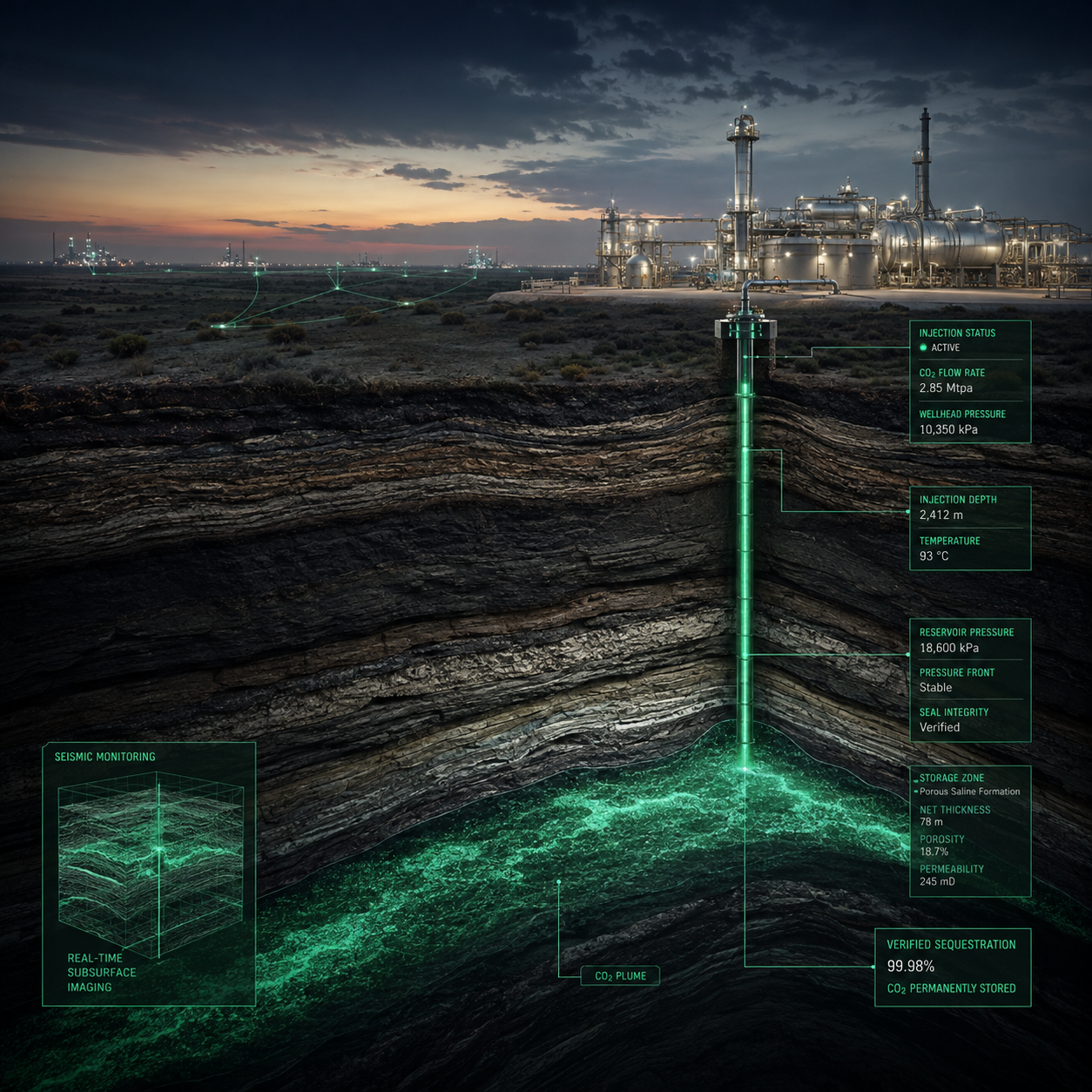
Rather than transporting the CO₂ to a distant storage site, the project uses an adjacent injection well. BKV acquires the CO₂ stream, compresses it and transports it to the well for permanent sequestration in deep geological formations.
The facility is designed to sequester approximately 90,000 tonnes of CO₂ per year.
Eagle Ford is also the first new project to enter service under BKV’s joint venture with Copenhagen Infrastructure Partners’ Energy Transition Fund I, following the addition of Barnett Zero to the partnership.
The project previously reached a final investment decision, obtained approval for its Class II injection well from the Texas Railroad Commission and secured approval of its monitoring, reporting and verification plan from the U.S. Environmental Protection Agency.
Cotton Cove Adds Another Operating CCS Site
Cotton Cove provides a second example of how CCS can be integrated directly with existing energy infrastructure.
The project is being developed by BKV and Banpu Power US and uses a Class II injection well to sequester CO₂ from BKV’s co-located midstream facility in the Fort Worth Basin.
The project achieved initial CO₂ injection earlier this year and is expected to average approximately 32,000 tonnes per year of sequestration over its operating life.
Together, Eagle Ford and Cotton Cove could provide more than 120,000 tonnes per year of CO₂ sequestration capacity.
Building From Operating Projects
The significance of the two facilities extends beyond their combined capacity.
Both projects use CO₂ streams associated with existing natural gas processing and midstream operations. This provides a practical model for integrating carbon management with industrial facilities that already produce concentrated CO₂ streams.
That integration can simplify part of the CCS value chain. Instead of developing capture, transportation and storage as entirely separate systems, projects can connect an existing CO₂ source with nearby or strategically located injection infrastructure.
The approach also provides operating experience that can inform larger projects as BKV expands its carbon management portfolio.
BKV Expands Its CCS Pipeline
The two operating facilities form part of a wider group of projects under development.
BKV has reported that its East Texas project remains on track for approximately 70,000 tonnes per year of CO₂ injection capacity.
The company has also entered into agreements with Comstock Resources to advance two additional CCUS projects associated with natural gas processing facilities at the Bethel and Marquez sites in the Western Haynesville.
Separately, BKV’s Class VI permit applications for its High West project have entered technical review with Louisiana regulators.
The development of these projects illustrates how carbon storage capacity can be built incrementally around existing industrial activity, while permitting, monitoring and injection infrastructure progress alongside the underlying projects.
What Commercial CCS Operations Mean for the Market
The transition from project development to actual injection is an important stage for the U.S. carbon management sector.
Operating facilities provide data on injection performance, monitoring requirements, infrastructure integration and the practical economics of permanent CO₂ storage. That
information becomes increasingly relevant as developers plan larger carbon management networks.
For industrial companies evaluating CCS, the question is also becoming more specific. The issue is no longer only whether carbon capture technology can be deployed, but how efficiently captured CO₂ can move from an industrial source to a permitted storage site and remain securely stored over the long term.
BKV’s Eagle Ford and Cotton Cove projects provide two operating examples of that model in Texas.
Their combined capacity is modest relative to BKV’s longer-term ambitions, but the projects provide an operational foundation for expanding carbon storage capacity across additional industrial facilities and geological formations.