
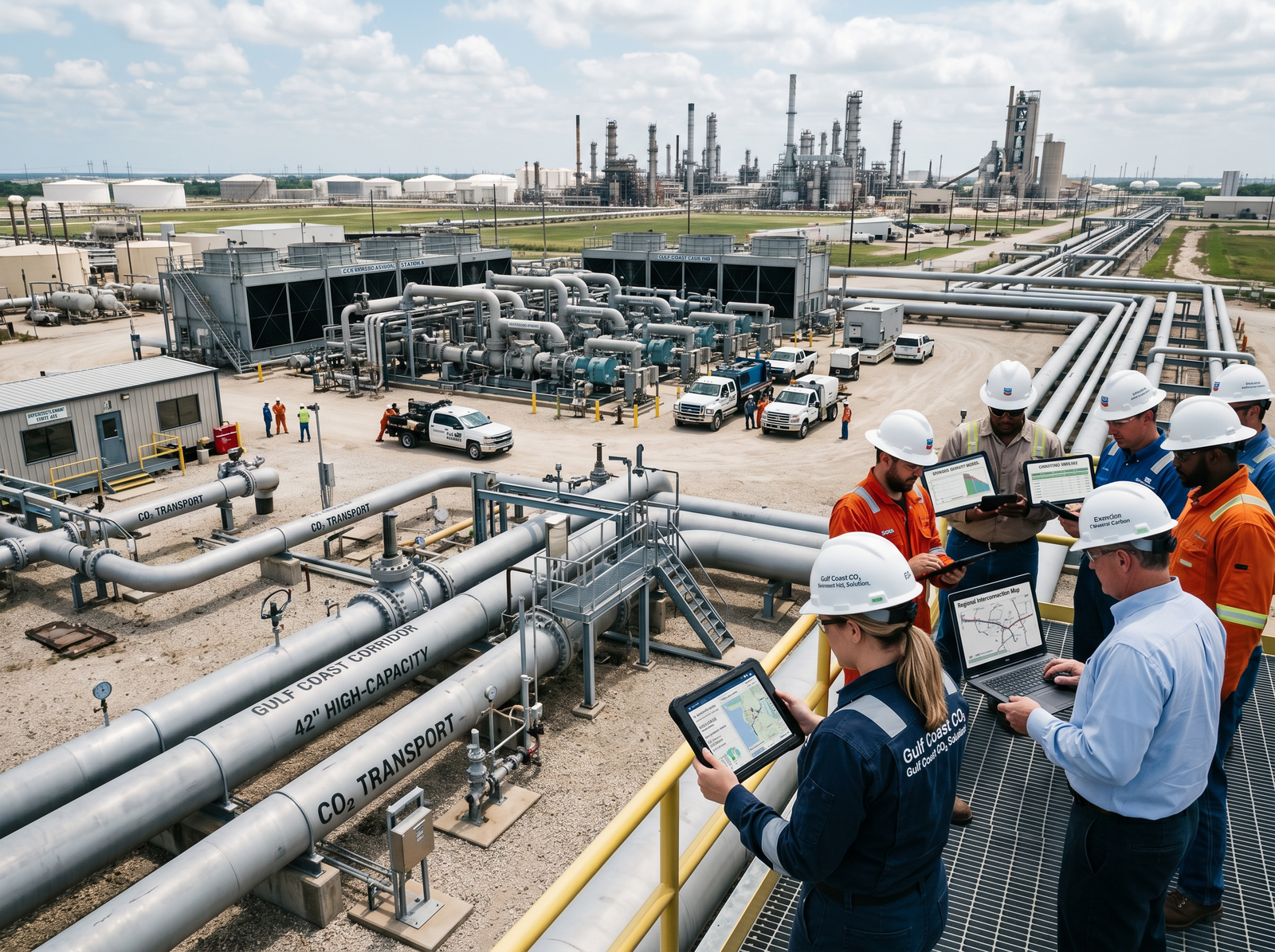
For more than a decade, carbon capture, utilization, and storage (CCUS) has been discussed primarily as a climate technology story.
The industry has focused heavily on:
● capture efficiency
● emissions reduction targets
● pilot projects
● policy announcements
● sustainability commitments
But as large-scale deployment accelerates, the conversation is changing. The biggest obstacle to CCUS expansion is increasingly not the capture technology itself. It is infrastructure.
More specifically:
the lack of large-scale carbon transport and storage networks capable of supporting industrial deployment at scale.
The Industry Has Moved Beyond the Technology Question
Carbon capture technologies are no longer experimental in many industrial applications. CCUS systems are already operating across sectors including:
● natural gas processing
● fertilizer production
● hydrogen manufacturing
● ethanol facilities
● petrochemicals
● cement
● steel
The engineering challenge today is less about whether carbon dioxide can be captured.
The larger question is whether captured CO₂ can be transported, stored, monitored, and financed efficiently across an integrated regional network.
Without that infrastructure, many projects struggle to move beyond feasibility studies.
Carbon Capture Without Transport Networks Has Limited Scale
Capturing carbon is only one part of the value chain.
Once CO₂ is captured, it must typically be:
1. compressed
2. transported
3. injected into geological storage
4. monitored long term
This creates a major infrastructure dependency.
Many industrial facilities are not located near viable storage sites. Others lack access to dedicated pipeline networks capable of moving large CO₂ volumes economically.
As a result, even technically viable projects may become commercially difficult without shared infrastructure systems.
In practical terms:
a carbon capture facility without transport access risks becoming an isolated asset with limited scalability.
Why Pipelines Matter More Than Public Messaging
Public attention often focuses on corporate net-zero announcements and sustainability targets.
But the operational reality is more complex.
CCUS deployment increasingly depends on:
● pipeline permitting
● regional storage access
● interconnection agreements
● liability frameworks
● compression infrastructure
● long-term monitoring systems
These are industrial infrastructure challenges rather than branding challenges. And unlike public relations campaigns, infrastructure development requires:
● capital coordination
● regulatory alignment
● multi-state cooperation
● long-term financing certainty
The gap between climate ambition and physical infrastructure remains one of the sector’s largest constraints.
The Rise of Carbon Management Hubs
One of the most important trends emerging in the CCUS sector is the development of carbon management hubs.
Rather than building isolated capture projects, companies are increasingly pursuing shared regional ecosystems where multiple emitters can connect to:
● common pipeline systems
● centralized compression facilities
● shared storage reservoirs
This hub-based model may significantly improve project economics by distributing infrastructure costs across multiple industrial participants.
Regions with concentrated industrial activity and suitable geology could gain substantial competitive advantages.
This is one reason Gulf Coast infrastructure continues to attract major CCUS investment attention.
Infrastructure Determines Project Bankability
For investors and developers, infrastructure access increasingly influences whether projects receive financing.
A technically successful capture system may still face major challenges if: ● transport costs remain high
● storage access is uncertain
● permitting timelines are unpredictable
● long-term liability frameworks remain unclear
Financial institutions are evaluating CCUS projects not only on capture performance, but also on infrastructure integration and long-term operational viability.
This shifts the industry conversation from technology readiness toward system readiness. The Permitting Challenge
Pipeline development introduces another major complexity:
regulatory approval timelines.
Large-scale carbon transport networks often require:
● federal approvals
● state coordination
● environmental reviews
● land access negotiations
● public engagement
These processes can extend project timelines significantly.
In some cases, infrastructure uncertainty may delay deployment more than capture engineering itself.
Lessons From Other Energy Transitions
Previous industrial transitions offer a useful parallel.
The expansion of:
● natural gas
● LNG export infrastructure
● renewable interconnections
● electricity transmission networks
all depended on coordinated infrastructure buildouts.
CCUS may now be entering a similar phase.
The companies and regions that build integrated transport and storage ecosystems early could shape the next generation of industrial decarbonization.
Final Thoughts
Carbon capture is increasingly moving from policy discussion into industrial reality.
As the sector matures, infrastructure is becoming the defining issue.
The future success of CCUS may depend less on improving capture rates and more on whether North America can build the transport and storage networks required to support industrial-scale deployment.
In that environment, pipelines may ultimately matter more than publicity.